There's some warped idea going around that anything "prideful" is bad. I have never subscribed to that and I won't, because I think the word itself is overused, and quite often as an accusation, either by those who are envious of ability, or who don't understand what's going on.
Of course, there is no doubt that sometimes pride does get in the way. How many times have you known a person to make a silly mistake and refuse to acknowledge it? That's pride, for sure.
But being proud of your own abilities? For pity's sake there is nothing more tedious than false modesty.
Recently I took part in the Nano writing event. I had never done it before because I could see a huge downside to it, but my pride caused me to get talked into it. This is a fact. I was pretty much dared. "Bet you can't write a book in a month." Well, I couldn't ignore that., Of course I can, I thought, I'll show them.
Of course I could. It's easy. You divide 50,000 by 30, which is just over 1600 words a day. I can do twice that before breakfast, so I did, and I finished it well ahead of schedule.
And it's complete rubbish. It's so bad that my pride would not let me put my name to it. Nobody will see it. It's crap. It cannot be saved because the premise was far too thin, I really didn't have anything interesting to say, and the only way to make it more interesting would be to add a LOT of very descriptive stuff about the scenery, making it half travelogue, and descriptive stuff is NOT my forté.
I know what I'm good at and what I'm not. This is a mixture of pride and realism.
However, there was one section I was really pleased with, a long monologue by one of the characters, which, with a very small amount of effort to change a word here and there, I can use in a different story that is working, and will get done in due course. Not rushed out like pulp fiction.
So it wasn't a complete waste of time. Plus, it proved what I had always thought, I'm only a good writer when the muse takes me. I really can't do it on demand.
But you know, I do have faith that I'm a good writer. And I do want to get something published. And because I have pride in my work I will wait patiently until I have something worth publishing.
As it is, there are plenty of actually very good books in the remainder bins. How sad is that. The world is saturated with good writing, just as it is with good musicianship, good artists, and so on. There is no use for a poor quality book, and I am not going to have a piece of junk "out there" with my name on it.
This is pride. So be it.
Wednesday, 18 December 2013

Tuesday, 17 December 2013
Laughing, it's a serious matter.
My matriarchy ever increaseth. I am grateful.
I've told you lot before, and I'll say it again, despite what anyone expects of me, I don't hand out a lot of parenting advice, because I'm not you.
Oh for SURE, there are aspects I disapprove of. There are things I think are important. It's not that I don't have plenty of opinions, it's just that I know what it's like to be a young mother trying her hardest, and being criticized by those whose opinions I don't want to hear, thank you very much. We all just do our best.
But here is a bit of advice I feel comfortable sharing.
Teach your kids to be funny.
There are all sorts of negatives in this world, but a person without a sense of humour is a walking tragedy. They have nothing to fall back on when life is unfair, or ridiculous, or plain brutal.
However, there's a proviso with this. In order to be funny, first you have to know what is serious. It's like everything else. There is a yin yang in life. A dark and a light. You cannot have one without the other.
Because just as there are those who are always serious, and look as if their faces would crack if they laugh, there are also those so frivolous, so "light" that they are pretty much 2D. Cardboard cutout people.
One of the things kids often get "wrong" is knowing the boundary, beyond which silliness becomes a problem for others. You remember doing it yourself, having the giggles and getting into Big Trouble for it, because it went on too long, or in the wrong place, at the wrong time.
So, they have to know when to stop.
But they also have to know when to start, and they learn both best by example.
This will come as no surprise to you but my kids were raised on Monty Python. It was already vintage by the time they were born, but it didn't really suffer for it. One of the reasons it stands out as classic comedy is that it dared to cross barriers, rarely crossed before. In doing so it often highlighted aspects of life we took too seriously, and by freeing minds up allowed us to judge what mattered, what we needed to take seriously.
Comedy is often thought of as very serious stuff!
In recent years satire has become mainstream but I'm not sure it's always understood. The masses, with their 3 second attention span, still prefer the cheap laughs. I've noticed that I can tell a LOT about a person's intellect and character as to whether they appreciate the likes of Python, or today's finest comedian Eddie Izzard.
Humour can be silly and clever at the same time. But only if you understand both, you see.
Let me show you, using Eddie as an example, how there are two types of clever funny.
#1 The All-Out Silly
#2 The Making a Point Using Humour
Kids can tell the difference, with a bit of guidance, and then...use it. They can state their case, express themselves, and see through the foolishness of society if they are well versed in educated silly.
Now I'm not going to tell you that everyone will understand it, because they won't. Some people never see the value of the clever and silly. Or maybe they do and it shows them up.
There is an advanced level. Some of you will not get this man at all. If you do, welcome to my world.
Saturday, 14 December 2013
Incurious
“There is a cult of ignorance in the United States, and there has always been. The strain of anti-intellectualism has been a constant thread winding its way through our political and cultural life, nurtured by the false notion that democracy means that "my ignorance is just as good as your knowledge.”
I have been accused of all sorts of things over the years due to anti-intellectualism, you know the sort of thing. The idea being that if you value knowledge it makes you some sort of elitist.
Just this week a friend (and by extension, in context, it also applied to me) was accused of being "over-educated."
This cropped up because she had objected to the poor English in some of these "memes" that go around with otherwise worthy messages. Like me she feels unable to share the semi-literate ones.
Somebody said "not everyone has the benefit of an education."
If you don't know by now, I dropped out of school at 17, I am officially UNeducated. What education I did get was poor, really poor. I had very little benefit there. What I had was the desire to learn more. I saw no value in ignorance. Virtually everything I know of any worth, I taught myself.
Have I done that more than necessary? Definitely. And I shall continue to do so.
But what does over-educated mean anyway? Is it simply a sort of envy - "you know more than I do and it's not fair!" or what? I don't think it is possible to be over-educated. How can you learn too much? Without a doubt, what you do with that education may not be all to the good but that's a separate issue.
It's all nonsense anyway. If you needed specialist surgery, you would not object to the doctor being over-educated. You'd want him to know as much as he possibly could.
I have no time whatsoever for reverse snobbery in regard to education. In Africa there are young children who walk miles every day for the opportunity to get an education. And you really don't need me to tell you the story of Malala Yousafzai.
So, no.
If, for whatever reason you are unable to learn, or you never got the chance to learn, or you don't want to learn, please don't turn it around and object to those who do. To put it another way, there's nothing clever about ignorance.
This morning I went to my local post office and was served by a very pleasant clerk. She is polite, friendly, and efficient. None of these, especially the latter, being guaranteed in post offices as I'm sure you know.
It would have been a very unremarkable visit if not for one off the cuff remark she made.
"I have never heard of Serbia."
I said nothing. I smiled. Not much you can say, is there?
I suppose I could have asked her if she'd been aware of any world events in the last 25 years, but one doesn't. She'd have felt silly, and I'd have looked like an arse.
I'm not sure which bothers me the most, that she works in a post office and has never been taught, or bothered to learn, at least the NAMES of all possible international destinations. Or that anyone, regardless of their job, can be oblivious like that.
I suppose she just doesn't care. I don't care that I've never heard of certain TV presenters, rap artists, or NASCAR drivers. I am not ashamed of my lack of knowledge in these areas. I suppose it's just a difference in areas of interest, or what one considers important.
I'll leave it Mr Fry to sum it up for me.
“There are young men and women up and down the land who happily (or unhappily) tell anyone who will listen that they don’t have an academic turn of mind, or that they aren’t lucky enough to have been blessed with a good memory, and yet can recite hundreds of pop lyrics and reel off any amount of information about footballers. Why? Because they are interested in those things. They are curious. If you are hungry for food, you are prepared to hunt high and low for it. If you are hungry for information it is the same. Information is all around us, now more than ever before in human history. You barely have to stir or incommode yourself to find things out. The only reason people do not know much is because they do not care to know. They are incurious. Incuriosity is the oddest and most foolish failing there is.”
Friday, 13 December 2013
Freedom from Fear
I am not afraid of much. They are pretty logical things too, for example I'm afraid of becoming unable to speak or move in old age and being fed bad food and forced to watch TV all day. The thought of that makes my blood run cold.
Somebody once said to me that they were only scared of things that threatened their life, like having a gun pointed at them, or being in an airplane with "problems."
I've done both of those. The gun didn't really bother me (and it was a German cop with a semi-automatic) because I figured if I just did as I was told it would be fine, and it was. And in the airplane having a hard time landing, I just resigned myself to the notion that I was going to die, which was very odd.
No, the scariest thing I've ever had to experience was when Sian's first child was born and took a long time to breathe. Ask me about fear then, or guess if you like.
When we talk about fear what springs to mind is phobias, or nightmares. We have all had moments of terror, and they are easy to recall, define, and attempt to avoid of course, but it's the lower levels of fear that cause more problems. Fear of failure (or, contrarily, of success,) for example, often causes inertia, and basically mucks up people's lives on an ongoing basis.
Fear of what others think is almost paralysing for some people. Instead of being who they are, wearing what they like, doing what they want to, they are stuck in some sort of loop of being fashionable, respectable, suitable, or "appropriate."
I keep running into people who tell me, with great relief, that as they get older they do more and more as they please, and worry less and less what others think. This is wonderful, but it tells me half their lives have been in a sort of self-imposed oppression. How much better could it have been if they had discovered this freedom earlier?
Lately I've been hearing a lot about shyness, or social anxiety, or any variation, definition, or severity of that sort of thing. Not just introversion, you understand. Not just preferring one's own company, but of suffering real discomfort when forced to interact with others. For a social species (and we are) how tragic is that?
Why isn't this recognized, addressed and FIXED for these people early in life?
Fear of being different, of standing out, of not being normal, is disabling. But if you look at society, for every time it says "Hey, let your freak flag fly!" it says the opposite ten times over. It says "CONFORM" in many and various ways. That's a very confusing mixed message, and no wonder young people, especially, hear the latter message.
For reasons of both nature and nurture, I am not afraid to be me. It's a fear I simply don't have. I recognize this as a massive advantage, a freedom, almost a privilege.
However, as I am learning from others who were not born that way, or whose early life suffocated their identity, it would appear it's also a choice. Like all choices, nobody said it would be easy. Nothing worth doing is easy. But if you can face that grumbling fear you can enjoy life far more.
Ask yourself, what exactly is it that I'm afraid of? If people look at me a bit funny, will the sky fall?
Instead of being horrified by the reactions of those who diapprove of you, you can, if you so choose, relish the effect you are having on them. Because by being your authentic self you are effectively teaching authenticity. You might be helping them too.

EDIT: Found this by chance after posting. Try this for size:

Somebody once said to me that they were only scared of things that threatened their life, like having a gun pointed at them, or being in an airplane with "problems."
I've done both of those. The gun didn't really bother me (and it was a German cop with a semi-automatic) because I figured if I just did as I was told it would be fine, and it was. And in the airplane having a hard time landing, I just resigned myself to the notion that I was going to die, which was very odd.
No, the scariest thing I've ever had to experience was when Sian's first child was born and took a long time to breathe. Ask me about fear then, or guess if you like.
When we talk about fear what springs to mind is phobias, or nightmares. We have all had moments of terror, and they are easy to recall, define, and attempt to avoid of course, but it's the lower levels of fear that cause more problems. Fear of failure (or, contrarily, of success,) for example, often causes inertia, and basically mucks up people's lives on an ongoing basis.
Fear of what others think is almost paralysing for some people. Instead of being who they are, wearing what they like, doing what they want to, they are stuck in some sort of loop of being fashionable, respectable, suitable, or "appropriate."
I keep running into people who tell me, with great relief, that as they get older they do more and more as they please, and worry less and less what others think. This is wonderful, but it tells me half their lives have been in a sort of self-imposed oppression. How much better could it have been if they had discovered this freedom earlier?
Lately I've been hearing a lot about shyness, or social anxiety, or any variation, definition, or severity of that sort of thing. Not just introversion, you understand. Not just preferring one's own company, but of suffering real discomfort when forced to interact with others. For a social species (and we are) how tragic is that?
Why isn't this recognized, addressed and FIXED for these people early in life?
Fear of being different, of standing out, of not being normal, is disabling. But if you look at society, for every time it says "Hey, let your freak flag fly!" it says the opposite ten times over. It says "CONFORM" in many and various ways. That's a very confusing mixed message, and no wonder young people, especially, hear the latter message.
For reasons of both nature and nurture, I am not afraid to be me. It's a fear I simply don't have. I recognize this as a massive advantage, a freedom, almost a privilege.
However, as I am learning from others who were not born that way, or whose early life suffocated their identity, it would appear it's also a choice. Like all choices, nobody said it would be easy. Nothing worth doing is easy. But if you can face that grumbling fear you can enjoy life far more.
Ask yourself, what exactly is it that I'm afraid of? If people look at me a bit funny, will the sky fall?
Instead of being horrified by the reactions of those who diapprove of you, you can, if you so choose, relish the effect you are having on them. Because by being your authentic self you are effectively teaching authenticity. You might be helping them too.
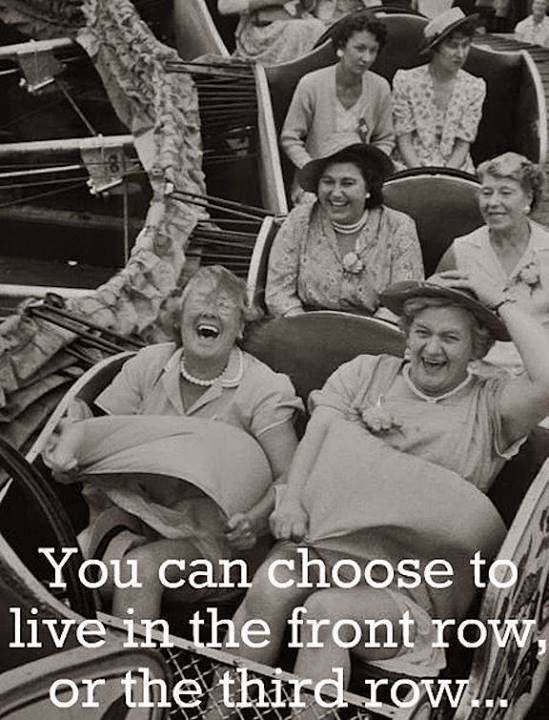
EDIT: Found this by chance after posting. Try this for size:

Thursday, 12 December 2013
Fear of Freedom
Some years ago in a debate about fundamentalism it occurred to several of us that one of its appeals was the avoidance of freedom. It is often suggested that there is a type of ease within authoritarian systems - you don't have to make many decisions, just play by the rules.
I am unable to relate to this. My basic character is one of rebellion against anything that makes no sense to me, and because for the most part I have been free to question everything, after half a century it is not just nature but ingrained.
It seems to me that the desire to just follow rules is a lazy way of thinking, but I don't like where it leads to, which is why I speak out against it rather than just shrug it off as somebody else's way of doing things. The key problem, obviously, is that these people want to the rest of us to follow their rules. That's not on.
You can't have missed the fact that a right-wing extremism has invaded the American Republican party. This used to be a very decent, respectable political party, but now it is a freak show of extremists with weird agendas. Unfortunately it is supported by a large number of Americans, which means that quite often it gets power at local and state level, and of course it would like to have power at a national level. It has failed in the last two Presidential elections but it'll keep trying.
Obviously there have been many times in history when authoritarian regimes have won power, one way or another. But it's when they are elected in that it's the most bizarre. When the people choose to be ruled in this way. The strangest of all has to be what happened in Germany in 1932. And you don't need me to tell you why it happened either.
Since then, we have been semi-alert to the risks of giving power to those who may may take a bit (or a lot) more as a result, lesson learned, sort of thing. It has even been over-used, such as in Godwin's law (q.v.).
Never mind all that, the fact remains that there are a lot of people who are so poor at coming to rational decisions that they wish to hand their power over to a leadership that will do it for them. They will happily elect a leader who lays down draconian rules, even totally inhumane rules, to avoid having to help work towards real solutions. Final solutions are so much easier.
If you've ever listened to these folk "discuss" major social issues, they're all about quick, simple, and inhumane. "Send 'em all back where they came from." "Just blow it all up." "Hang the lot of 'em."
Any objection to these suggestions will lead to you being insulted. An ad hominem attack. This is the usual, first (often last) tactic of those with no real argument. Here's that list again.

It simply proves their lazy thinking, their preference for authoritarian methods, and their fear of freedom. Right there. They cannot be bothered to consider any alternative.
So, I have asked for a book for Christmas. Erich Fromm wrote "Fear of Freedom" in 1941 (you may know it as "Escape From Freedom") As a German Jew who had made an early decision to get out and settle in the US before WWII, he was well aware of authoritarianism, but the book is not about his own experience. It's about a much earlier period in history where the lack of freedom brought mostly ease and comfort, despite hardships. I am looking forward to reading this, and you can be sure I'll report back.
What I think happens, at any time in history, is a false memory of a bygone age where everything was easier, safer, more comfortable, and it is this that people wish to return to. Even the desire (often voiced!) to return to childhood, with all of its rules. Children are in so many ways oppressed, and don't object very much.
It might also explain why some women seem to appear quite contented to be dominated by a man. And indeed why some men seem so happy to be dominated by women.
So, one could argue that it's personal choice, except it isn't. Because it almost always involves domination over others who do not wish it. And even those who are really very happy not to be leaders do not necessarily wish to have leaders who are cruel.
Obviously if your personal choice is to live under a strict set of rules, that's an option you should be free to make (hmmm....) The military might be a good fit, or clergy. What I rail against is when you decide that I need your rules too. Thankfully, I'm not alone.
Wednesday, 11 December 2013
Toxic People

One of my first blogs here was about Emotional Vampires.
http://chovblog.blogspot.ca/2012/11/this-is-image-currently-doing-rounds-on.html
And here's a good article on the topic:
http://www.canadianliving.com/health/prevention/how_to_spot_an_emotional_vampire.php
Assuming you know what I'm talking about then, I'll continue.
Just lately I have had to help several people I care about who are having to deal with these types, and there have been a number of discussions in my circles on the topic.
Let's be clear. You cannot reason with these people. You can find yourself spending a lot of time trying, you may have all sorts of ideas on how you will "get through" but you won't. There is something wrong in their thought processes.
It causes them endless problems. Their lives are not happy. But it will do you no good to feel sorry for them, because there is nothing you can do.
A very kind friend of mine, in one of these discussions said:
"Everyone needs love, these people are no different."
Fine, but you don't have to be the one to give that love. Because it won't be appreciated. That's the whole point. As a loving, giving person of course you feel the need to give love to everyone, but let me give you an analogy to see the problem here.
Let's say you have a garden. You grow a variety of plants. Some of them are pretty flowers, some are things you can eat, and some are thistles that do nothing for you at all. They are still plants, they still have a right to exist, but they don't have to do it in YOUR garden. You can pull them out.
When you tend your garden, you do so by ensuring it has everything it needs. Sunshine, water, nutrients, and so on. Maybe even a barrier to keep bugs away. You treat all the plants the same. You effectively give them love. But no matter how much love you give a thistle, it's still a thistle. You could spoil it rotten, give it the finest fertilizer, never let one single aphid settle on it, it will always be a thistle.
Not only that, if you don't remove it from your garden, it will take all the nutrients that the other plants need, and in time will take over the garden. It will effectively crowd out the other plants. If you don't get rid of it early on, it will take all your time pulling out thistles. Therefore, for your benefit, and for the benefit of the rest of the garden too, weeding is the only sensible solution.
In other words, you have to have a limit.
There are a couple of named, diagnosed disorders out there, Narcissistic Personality Disorder, and Borderline Personality Disorder. Like all disorders, these vary in severity and there are always those who don't quite meet the criteria, but come close.
These toxic people are sometimes on one of those scales, or something similar.
And they can't help it. It's part of who they are. There's no cure. But being compassionate simply enables them, so it's the last thing you should do.
People who love you do not do things to hurt you. If somebody in your life is deliberately causing you harm, however subtle that is, this is not love. It doesn't matter how many times they say they love you if their actions prove otherwise.
So, in an interesting twist, a friend of a friend complained of being shunned, and that this was unkind. I know nothing about this girl, and I have no idea what sparked the shunning. So I didn't have much to say, but as I was privy to it I asked:
"This shunning, is it the only thing they are doing?"
The answer was yes. Nobody had been unkind to her in any other way. It hadn't happened all at once, it was gradual.
My guess is that the girl is toxic, and everyone has reached their limit with her.
But it would do me no good to tell her that, even if I was sure it was accurate. The simple fact that she doesn't understand why she's being shunned proves that she simply doesn't get it. I bet she's had plenty of warnings, and ignored them. The fact that "everyone" is doing it is the biggest clue that the problem is her. But she can't even see that most obvious, basic clue.
I've said before that while listening to criticism is usually discouraged, if there is consensus among one's critics it might be time to give it some thought.
Understanding all of this requires a type of analysis that these folk are not capable of. They can't see what they did wrong. THEY CAN'T.
Tuesday, 10 December 2013
Freedom to be an Arsehole
Some years ago, I think maybe in the 80s, I became aware of the word assertive. It was new to me at the time. It described me very well, and therefore I liked it, but it wasn't being used as a compliment for me.
I came across it because people were taking "assertiveness courses" sometimes but not always offered through places of work. It was a trend, I think. Wasn't something I needed so I didn't pay much attention.
What I discovered was that people were confusing "assertive" with "arsehole." Maybe they were already arseholes but now they were confident arseholes, outspoken arseholes, in your face arseholes.
What this assertiveness training did, in effect, was encourage the ME, ME, ME attitude these folk had never shaken off from childhood.
This is the "Me First" attitude that causes drivers to think they own the road, that causes people to push to the front in any crowd, or even line, that causes neighbours to park in front of your driveway, that causes parents to insist their kid gets more play time on the team.
And it's the mindset that says "My needs come first, so you don't matter."
What we have here in fact is the Altruism scale.
Just as with saying too much or too little, there is a balance on this scale. There is Selfish at one end and Sucker at the other. It's also an area where we tend to be very quick to offer advice.
"You are letting people push you around, you're too soft, you should stand up for yourself."
or
"You are so selfish, you should think of other people."
Can you see either of these statements working? No, neither can I.
People don't take criticisms and "shoulds" well, and you can't really expect them to.
You could try "Ever thought of considering the other guy?" and variations on that, but it may not work any better.
Oh yes, I have told people "you are an arsehole." Certainly. But unless they are ready to hear it, they won't.
And I have told people along the lines of:
"It is your absolute right to be an arsehole."
Because it is. One of the last remaining freedoms, after all of the others are taboo or illegal, is the freedom to be selfish, spiteful, cruel, nasty, or just thoughtless.
Like anything else, it's a choice. Like many choices it's often not made from careful analysis, but from expediency, ease, habit, example, and general negativity. I don't think anyone consciously decides to be an arsehole, I hope not anyway.
What about the other extreme, who chooses to be a pushover? Some people definitely decide that on balance they'd rather be too soft than too hard, and it's a conscious choice, but there are also those who just allow themselves to be manipulated.
I have noticed a peculiar thing. People who are manipulative can often be easily manipulated too. I've noticed this in Vampira, the pseudonym for an inlaw one of my kids has to deal with. Vampira is a pushover, but also assumes everyone else is. Hmm, yes. you don't need to be assertive to be an arsehole.
Subscribe to:
Posts (Atom)